
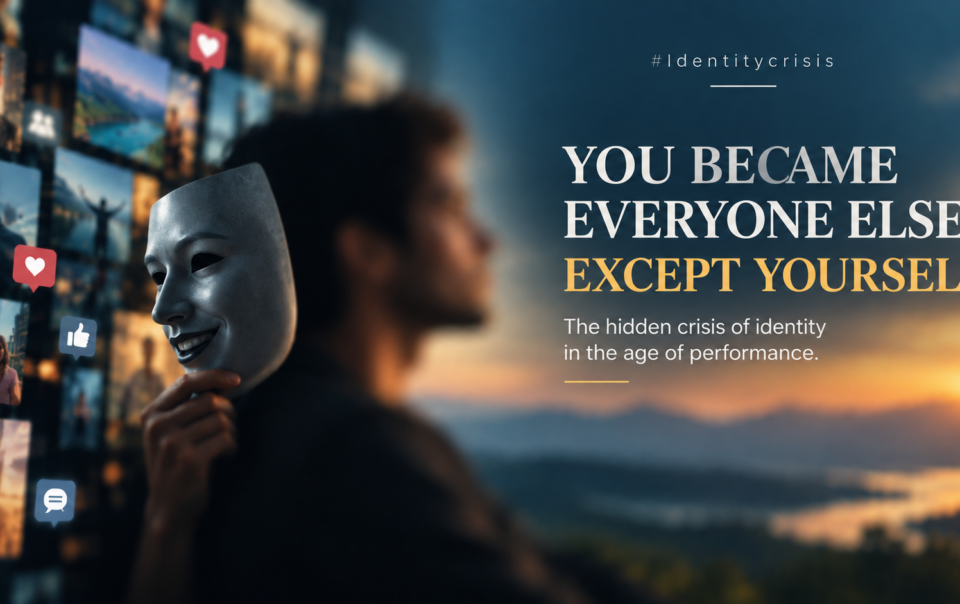



We keep blaming technology for changing the world. That’s convenient and wrong. Technology didn’t create this problem. It exposed it. What we are witnessing today is not a social media crisis, a generational flaw, or even a cultural shift.
It’s an identity gap—the widening distance between who people are and who they feel compelled to appear as.
Most people today are not living one life. They are managing two:
And the projected life is quietly becoming more important than the real one. Not because people are fake—but because they are uncertain.
A common argument is that people today lack integrity. That they chase:
There’s some truth there. But reducing this to “people have no morals” is intellectually lazy. The real issue is deeper: People don’t know who they are—so they borrow identities.
What looks like confidence is often imitation with good lighting.
Let’s address the obvious contradiction. Some people ignore all this—and seem perfectly fine.
And yes, they often look happier. But that’s not clarity. That’s low internal friction. There’s a difference. Others—usually more self-aware—experience the opposite:
They are not weaker. They are simply less willing to live unconsciously.
Social media didn’t invent fake identities. It made them scalable. It turned identity into something that can be:
And once validation becomes measurable, identity becomes performative. The dangerous shift is this:
People no longer ask “Who am I?” They ask “What version of me works best?”
This problem isn’t limited to teenagers. In fact, it becomes more critical later. People in their 30s and 40s face a harsher version of the same gap:
This is where identity tension turns into a crisis. Not because life failed— but because expectations were never grounded in reality to begin with.
Here’s where it gets uncomfortable. Entire industries are quietly built on this gap. They don’t just sell products. They sell identity shortcuts:
The promise is simple: You don’t need to become—just acquire. And people buy it. Repeatedly. Because it’s easier than doing the internal work.
This isn’t just a personal issue anymore. When people who are internally divided raise the next generation, they don’t pass clarity. They pass confusion.
Not through advice—but through behavior. A child doesn’t learn what you say. They learn what you embody.
We keep asking: “What is wrong with this generation?” The better question is: “Why are we so uncomfortable being ourselves without an audience?” Until that is addressed, no amount of Success, Validation, Consumption, and Reinvention will close the gap. Because the problem isn’t external. It’s the silent distance between who we are and who we perform. And that distance is where most people are living today.