
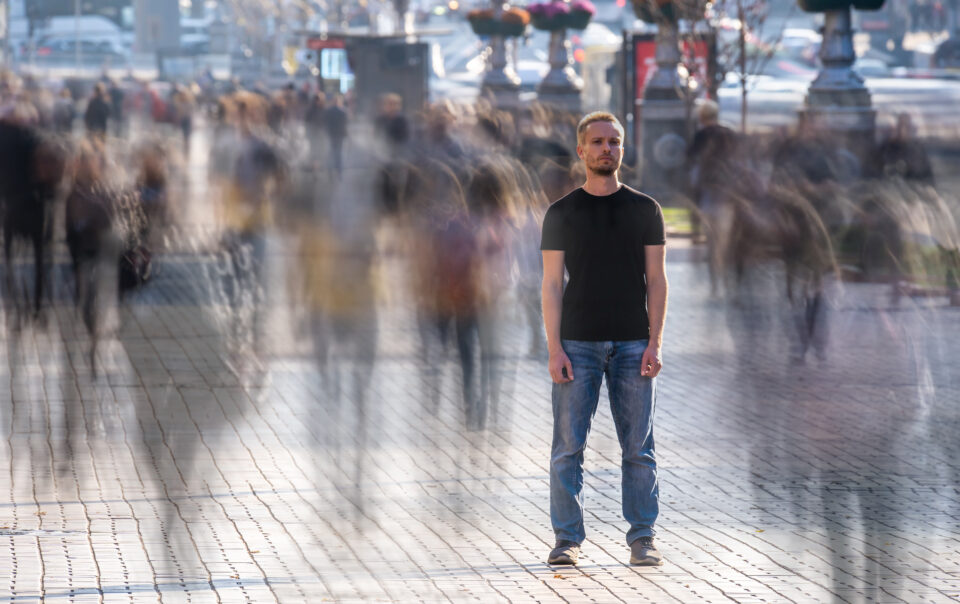



The crisis of our time is not economic, technological, or even political. It is existential.
In this digital age, identity has quietly shifted from something discovered to something performed. Visibility has replaced being. Attention has replaced meaning. What was once an inward inquiry has become an outward spectacle.
Social and digital media didn’t cause this crisis; they just amplified an already fragile sense of self. The person has no clue who they are and requires constant validation to feel like they matter. To be invisible now is to be unreal. This anxiety is not only for adults but is increasingly passed on to children, who learn early that their worth is measured by applause, not by understanding.
In this economy of attention, people begin to manufacture identities. The self becomes a project—curated, edited, exaggerated. What is natural appears insufficient; what is quiet appears irrelevant. One must appear “special” to matter. Ironically, in trying to become extraordinary, people surrender the one thing that cannot be replicated: their own nature.
Philosophically, this view is a deep misunderstanding of individuality. Individuality is not difference for difference’s sake. It is not rebellion, eccentricity, or aesthetic uniqueness. True individuality is alignment—being rooted deeply in one’s own constitution, abilities, limits, and responsibilities. When this alignment is absent, difference becomes performative, and performance eventually turns into imitation.
This is how mob mentality is born, not in uniformity but in shared insecurity. When individuals do not know themselves, they borrow certainty from the crowd. Opinions are outsourced. Beliefs are inherited. Moral positions are adopted based on popularity rather than insight. The crowd offers comfort, but it demands conformity.
The same psychological pattern manifests at a collective level. Nations, like individuals, suffer from identity confusion. Instead of understanding ones own historical, cultural, and social realities, they compare themselves relentlessly with others. Development becomes mimicry. Progress becomes measurement against foreign benchmarks. In this process, the nation may modernize, but it does not mature.
A society without a clear sense of self cannot build a future; it can only import one.
This situation is where marketing and ideological narratives gain disproportionate power. When people do not ask who they are, someone else is always ready to tell them. Consumption becomes a substitute for meaning. Identity is reduced to lifestyle, political slogans, brand affiliations. Thought is not made by question, but by reiteration.
The deeper tragedy is not manipulation but a disengagement from the fundamental questions: Who am I beyond roles and labels?
What capacities have I been entrusted with?
What is my responsibility within this interconnected web of life?
How does my inner disorder contribute to social disorder?
These questions are uncomfortable because they demand accountability rather than expression. They require silence rather than performance. Without them, a human being remains socially active but existentially hollow.
Civilizations never advance by imitation, but by self-knowledge. The societies built on wisdom create people who know their place in the whole, who are not bloated with narcissism and not dissolved into the crowd. When individuals are grounded, institutions become humane. When individuals are fragmented, even the most advanced systems turn predatory.
To emerge from the identity crisis, one must abandon the obsession with being “different” and instead undertake the more difficult task of being honest. Authenticity is not expressive freedom; it is disciplined self-understanding. It requires recognizing one’s gifts without exaggeration, one’s limits without shame, and one’s role without illusion.
If this inner work is avoided, the end is predictable. A life lived through borrowed identities eventually confronts itself. And when the question “Who am I?” finally arises, the answer echoes back with unfamiliar faces, borrowed voices, and inherited beliefs—but not the self.